Assertive communication - what is it, why does it matter and how does it change your relationships and your results?
What is assertive communication?
Assertive communication is a style of communication in which we express our thoughts and needs clearly, honestly and firmly, while respecting the other party's boundaries. It is the happy medium between passivity and aggression: taking responsibility for yourself without destroying the relationship.
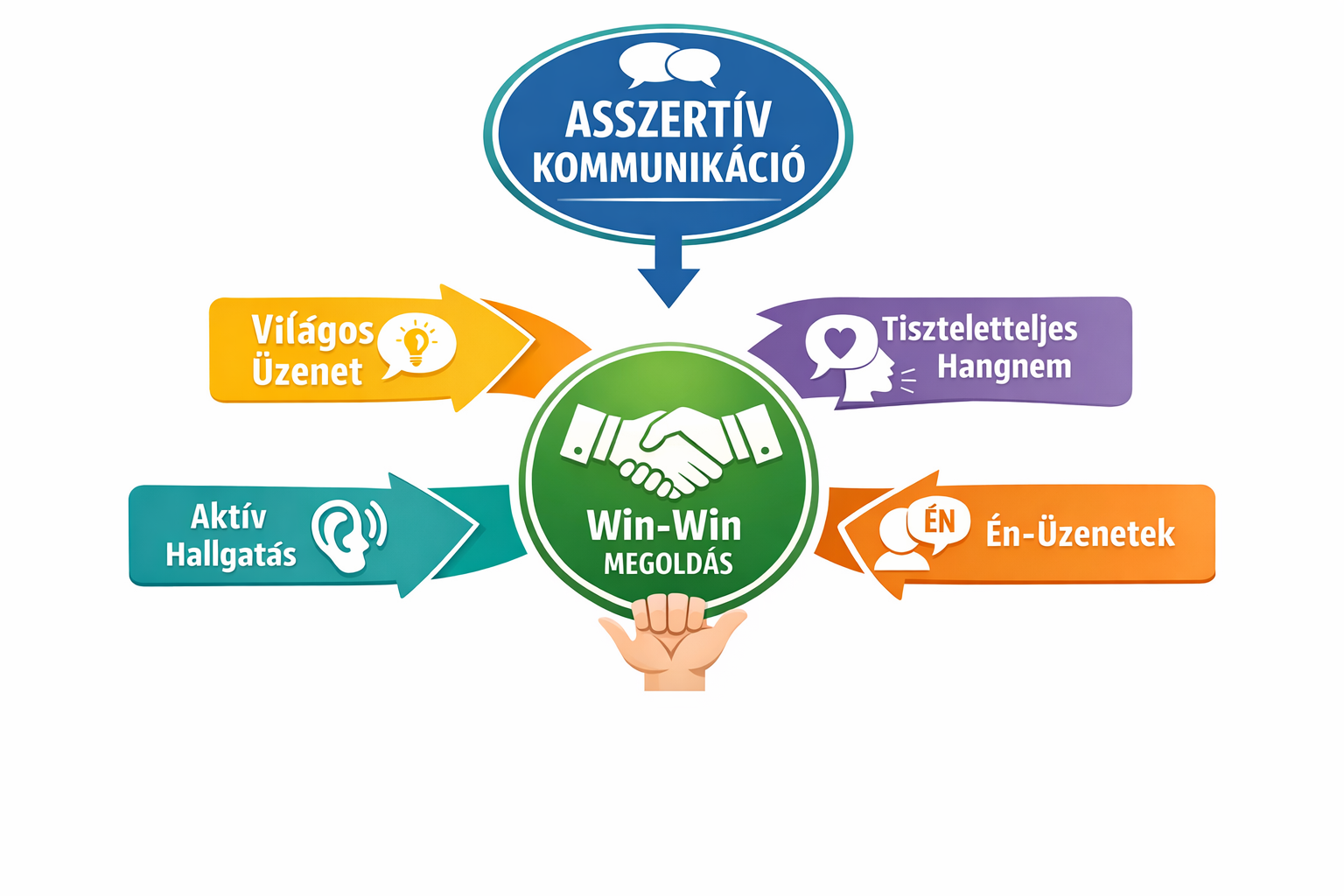
This definition is concise for a reason. The essence of assertiveness is simple - but putting it into practice requires deep self-awareness and awareness.
What is assertiveness - and how is it different from assertive communication?
assertiveness ≠ assertive communication
Assertiveness is an internal mode of operation: the ability to be aware of and take responsibility for your feelings, needs and limits. Non communication technique, but inner stability, which determines how you react in situations.
The assertive communication but this inner assertiveness the external, visible appearance: how you speak, set boundaries and react to others in a situation.
What happens if you are not assertive? - do you recognise yourself in these situations?
The lack of assertiveness is rarely spectacular.
It does not start with loud conflicts, but with small, internal slips.
You might recognise it:
- you say yes when inside you feel no
- after a conversation, you are left with tension, but you can't quite put your finger on why
- in hindsight, what you should have said
- you prefer to remain silent because „it's not worth the conflict”
These are not communication errors.
These are internal border problems.
When you are not assertive, the unspoken sentences do not disappear - stay inside you.
As tension, irritability, recurring thoughts.
Many clients seek coaching not because they „communicate badly”, but because tired of always adapting.
Ask yourself honestly:
- When was the last time I said no without explaining myself?
- How many times have I kept something quiet just to avoid upsetting the situation?
- What would happen if I said what I really feel or want?
If these questions are uncomfortable, that's fine.
This indicates that concerns the subject.
And that's why the next part is important:
the scientific background is interesting not because it „proves” but because it shows that what you are experiencing is not an individual fault, but a well-described, researched human function.
If you read several sentences and think „that sounds familiar”, the problem is probably not your communication skills, but the fact that you have been trying to solve it on your own.
Scientific background and credible sources on assertive communication
Assertive communication is not only a coaching concept, but communication style based on psychological theories and research. This is supported by the literature on the role of emotional intelligence and empathy, as well as structured communication models.
Marshall B. Rosenberg - Nonviolent Communication*
The elements of assertiveness are closely linked to the psychologist's Marshall B. Rosenberg developed by Nonviolent Communication (EMC / NPC) methodology**. According to Rosenberg's model, effective, respectful communication is based on a structure of facts, feelings, needs and requests, which helps to resolve conflicts peacefully and improve the quality of relations. This idea is also reflected in the practical techniques of assertive communication.
Often used symbol of the EMK the „giraffe language”, which, according to Rosenberg**, represents the idea of clear, empathic and self-assertive communication - as opposed to automatic, emotionally impulsive „jackal language”. Wikipedia
Emotional intelligence and assertiveness
Modern communication research emphasises that the assertive style not an isolated technique, but also the emotional intelligence (EQ) is based on a higher level of functioning. EQ enables you to consciously recognise and regulate our feelings, which is essential for authentic and respectful „I-messages” - and thus for assertive communication itself.
*Marshall Rosenberg: Az "asszertív kommunikáció" szinte elválaszthatatlan az ő nevétől és az From Nonviolent Communication (NPC).
**Nonviolent Communication (NCC) - Marshall Rosenberg's psychological model - empathy + assertiveness-based communication that supports conflict management and relationship quality in a structured way (e.g. Non-violent communication - Wikipedia) Wikipedia
What really blocks you from being assertive? - coaching approach
Many people think they cannot communicate assertively because:
- not strong enough
- they cannot find good sentences
- „that's their personality”
The coaching experience shows otherwise.
The most common blocks not communication, but internal barriers.
Many people realise here that the problem is not with the sentences.
It's about trying to find their way on their own in internal situations for which they have not been given a model before.Coaching is not advice, but a supported space for thinking where you can safely untangle these situations - using concrete examples from your own life.
Conformity constraints
When your value is internally linked to what others think of you, saying no seems like a risk.
You are not silent because you have no opinion - but because you fear the consequences.
Conflict avoidance
Many people confuse assertiveness with conflict.
But assertiveness is not looking for conflict - prevents build-up of tension.
Conflict avoidance, on the other hand, provides short-term peace of mind, but in the long term it sets the stage for an internal explosion.
Uncertain internal borders
If you are not clear about what you feel and what you need, you cannot represent it.
Communication then becomes uncertain, because nothing to build on.
This is where training and coaching become distinct.
Developing assertiveness in coaching does not start with practising sentences, but with:
- you notice, what happens inside you in a situation
- you name, what you feel and what you need
- learn to represent yourself safely all from
This is why we say that assertive communication not a collection of sentences.
If there is no order inside, even the most beautiful „I-message” remains empty.
This is a a learnable process, en not a quick trick and that's it.
The first step is often to give oneself permission to take one's own inner reactions seriously.
This is how assertiveness building in coaching typically takes place:
- recognise the recurring situations where you get stuck
- name your feelings and needs
- learn to keep your internal position even when the other party's reaction is uncertain
When they become conscious, the option to choose appears.
You don't react automatically, you decide.
And from here it becomes clear why we say that assertive communication not a collection of sentences.
Sentences are just tools.
Real change happens where internal stability is created - This will be the basis for the models and techniques presented in the following chapters.
Assertive communication doesn't work by „being more articulate”, it works by looking at what is happening inside you in a situation from a safe space.
That's what coaching is all about: not giving you ready-made answers, but helping you find your own answers that work.
Assertive communication is not just a technique
Many people think the assertive communication „a collection of ”good sounding phrases".
In reality, this is internal operation, which is expressed outside communication.
The basis for assertive communication:
- self-awareness
- emotional intelligence
- psychological safety
- taking responsibility
If these are missing, even the best sentence will be artificial.
Passive, aggressive and assertive communication - the crucial differences
| Style | Featured on | Result |
| Passive | concealment, over-employment | internal stress |
| Aggressive | attack, classification | contact destruction |
| Assertive | clear boundaries + respect | confidence, stability |
The assertive person is not „louder”, but more stable.
Not a winner in every situation - but does not lose itself.
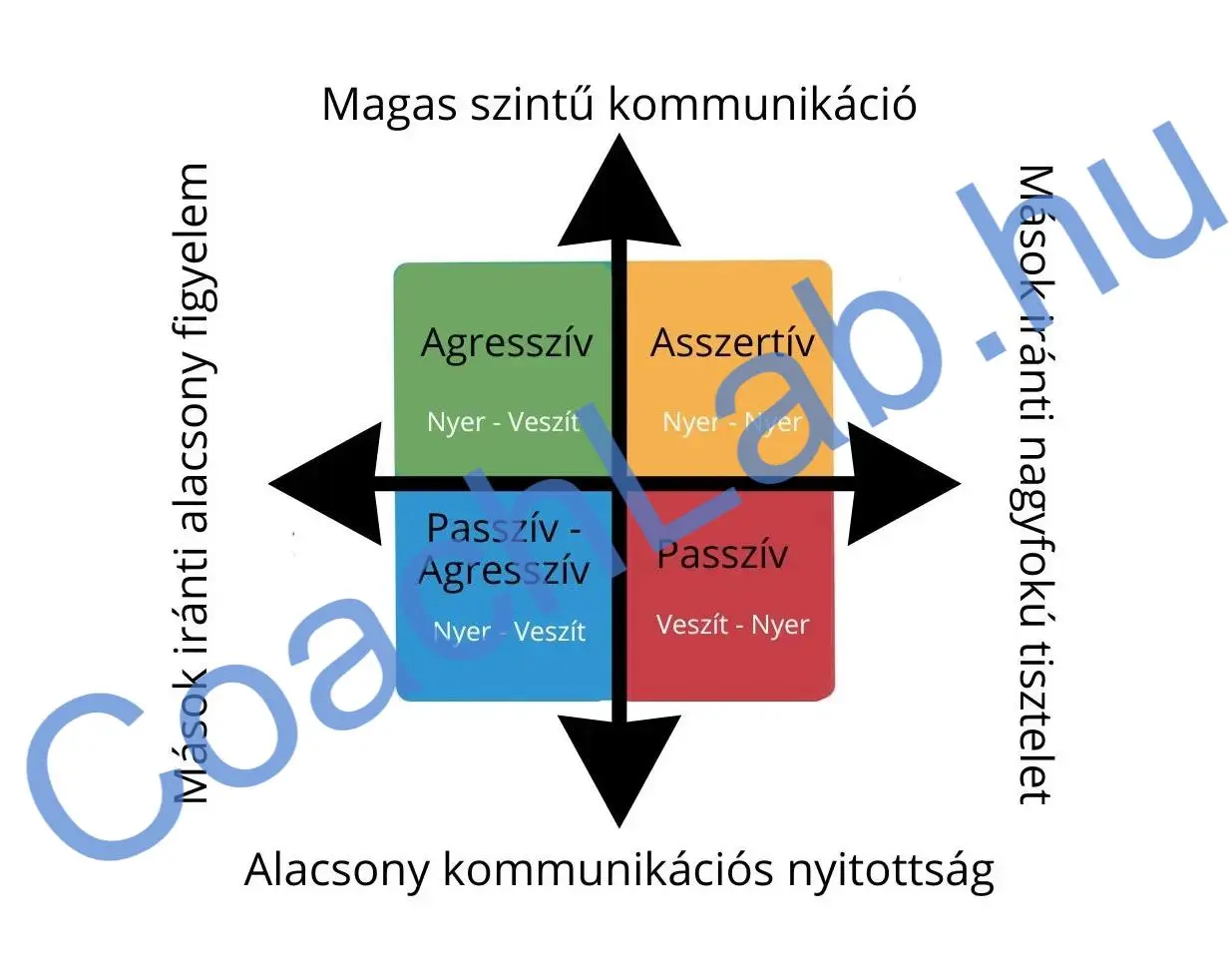
Asszertív, passzív és agresszív kommunikációs stílusok összehasonlítása – ábra a hatékony önérvényesítésről_RR - image created by CoachLab
Asszertivitás vs. Agresszivitás - Mi a különbség?
Why does assertiveness not equal selfishness?
A common misconception is that assertive people „walk all over others”. In fact assertiveness is the happy medium between passivity and aggression.
Featured on Passive Aggressive Assertive Target Conflict avoidance Victory at any cost Solution and understanding Self-esteem Low („I don't count”) Dominant („Only I matter”) Healthy („I matter and you matter”) Result Internal tension, resentment Broken relationships Long-term trust The essence of assertive communication is psychological safety standing up for yourself without violating the dignity of others.
The psychological background of assertive communication
Assertiveness is closely linked to several areas that are key concepts in coaching:
- Emotional intelligence - you recognise and name what you feel
- I-messages - you don't accuse, you talk about yourself
- Active listening - you really hear the other person
- Transaction analysis - Adult-Adult communication, not a game
This is why it often happens that someone „tries to be assertive” but it doesn't work.
Internal uncertainty always seeps into communication.
Workplace situations where assertive communication is particularly important
Situation: too many tasks, constant overload.
- Passive: „Okay, I'll do it...”
- Aggressive: „It's on me again!”
- Assertive: „When I have several urgent tasks at the same time, I feel stressed because it's difficult to maintain quality. I want us to prioritise together.”
This is not a confrontation.
This is responsible cooperation.
(If this situation sounds familiar, in coaching we develop phrases exactly like this for your own real-life examples.)
Assertive communication in couples
In the relationship assertiveness is difficult because we are there the most vulnerable.
Not assertive:
„Whatever, do it your way.”
Assertive:
„When you make a decision like that without me, I feel disappointed, because I care about the joint decision. I want us to talk about it.”
Intimacy does not mean freedom from conflict, but honest, secure communication.
Assertive no techniques
The assertive saying no not an explanation and not a defence.
Basic formula:
„I understand your request and I'm going to say no, because it's not in my capacity.”
No „but”.
No self-corroboration.
Saying no border protection, not destroys relationships.
Asszertív nemet mondás - A határok kijelölése
How to say no assertively?
Setting boundaries is the foundation of mental health. Saying no assertively does not require lengthy explanations or guilt. The simplest techniques:
- The direct no: „Thank you for the opportunity, but I can't do it now.”
- Empathic is not: „I can see you're under a lot of pressure, but my calendar is full so I can't help you.”
- A time-saving technique: „I have to review my priorities, I'll get back to you tomorrow morning to see if I can fit it in.”
Remember: when you say no to an extra task, you are actually saying yes to your own focus and quality work.
The 4-step model of assertive communication - practical cheat sheet
This method is closely linked to Marshall Rosenberg's Nonviolent Communication (NPC) model...
This model is also often used regularly in coaching:
„When you [specific behaviour], my [feeling] I feel, because [effect]. I ask., that [request].”
Example:
„When you arrive late, I feel stressed because it's difficult to keep to the timeframe. I ask that we start on time next time.”
This:
- Clear
- non-offensive
- in contact with
If you would like to translate these situations into your own life, we work with concrete examples in coaching: situations, feedback, practice.
Common mistakes when trying to be assertive
This is one of the most important parts, because this is where most people slip.
- Covert aggression
„I'm just being honest” - while you accuse. - Excessive politeness
So much embellishment that the point is lost. - Rating disguised as an I-message
„I feel you are disrespectful.” - this is still an accusation. - Bad timing
Assertiveness does not mean always and immediately speaking up.
Two proven assertive tools: the DESC and the „record player” (Broken Record)
Below is a concise, professional focus on these:
The practice of assertiveness: the DESC model
The DESC Feedback Model - the communication tool, developed by Sharon and Gordon Bower and discusses in detail the Asserting Yourself (Source: Wordmotion)
A DESC model provides a structured framework for assertive feedback and conflict management. Its abbreviation consists of the initials of the steps:
- D - Describe
Reporting facts and observations without evaluation or qualification.
„The meetings have started 20 minutes late on the last three occasions.” - E - Express (Érzések, hatás kifejezése)
Expressing own feelings or consequences with „I-messages”.
„This makes it difficult for me to plan my work.” - S - Specify (Kérés, elvárás konkretizálása)
A clear, specific request or expected behaviour.
„I would like us to start on time in the future.” - C - Consequences (Következmények)
Positive (possibly negative) consequences.
„This way we can move more efficiently and there will be fewer delays.”
When to use:
- visszajelzés adása
- határok kijelölése
- munkahelyi konfliktusok kezelése

„Record player” technique (Broken Record)
A „broken record” technique i.e. the short/repeater asszertív kommunikáció - widely known in assertiveness training and communication literature. (Wikipedia - Broken Record Technique)
A turntable technology a tool for assertive perseverance. The idea is that the same basic message calmly, consistently, repeated over and over again, regardless of counter-arguments, manipulation or emotional pressure.
Main features:
- short, simple sentences
- unchanged content, wording may change
- no explanation, discussion or defence
Example:
- „I can't do this job.”
- „I understand it's important, but I can't do it.”
- „I can't do it now.”
When it is effective:
- határátlépési helyzetekben
- nyomásgyakorlásnál
- passzív-agresszív vagy manipulatív kommunikációnál
DESC vs. Broken Record short comparison
| Viewpoint | DESC model | Turntable technology (Broken Record) |
|---|---|---|
| Target | Structured feedback | Consistent border protection |
| Length of communication | Medium | Short, repetitive |
| Flexibility | Explanatory nature | Not flexible in content |
| Typical situation | Conflict, evaluation | Pressure, persuasion |
When is it not worth being assertive?
An important shade.
It is not ideal to be assertive:
- in a crisis
- in an emotionally overwrought state
- in a psychologically unsafe environment
In this case, first self-regulation, only then communication.
Quick self-test - how assertive are you?
Answer honestly:
- Do you often say yes when you feel no?
- In hindsight, what should have been said?
- Do you avoid conflict and then get angry inside?
- Say what you mean, but regret the style?
If more than two, yes:
az asszertív kommunikáció fejlesztése keyword at your place.
Assertiveness, leadership and credibility
Simon Sinek people do not follow it, with you say, but that, why.
The assertive leader:
- not playing games
- sets clear expectations
- creates psychological safety
Therefore, assertiveness basic leadership skills, not communication extra.
How does coaching help?
Coaching is not a collection of phrases.
A process where:
- recognise your own communication patterns
- work on internal insecurities
- you bring in real situations
- you practice, you get feedback
Assertive communication Result, not a starting point.
If you want to see how this works in coaching, please feel free to contact us.
A TED video on assertiveness:
The beauty of self-empowerment | Dr. Abby Hamilton | TEDxWestshoreWomen
Frequently asked questions about assertive communication (FAQ)
What is the difference between assertive and aggressive communication?
Aggressive communication asserts yourself at the expense of the other, assertive communication stands up for yourself while respecting the other.
What are the pillars of assertive communication?
Self-awareness, responsibility, emotional intelligence, psychological safety and clear boundaries.
Can assertive communication be learned?
Yes. Not a personality trait, but a skill that can be developed, especially coaching in progress.
Does assertive communication work in all situations?
No. In a crisis situation or a strong emotional state, self-regulation is needed first.
How do I know that I am communicating passive-aggressively?
If you often don't say what you want outright, but express disapproval with innuendo, cynicism, procrastination or “punitive silence”, this is a typical passive-aggressive sign. The assertive course is to state your specific needs and requests - without qualification.
What if I speak assertively and the other person takes it as an attack?
Briefly reflect back your intentions and keep the frame, „I'm not trying to attack you, but to clarify what I need.” If the other party continues to escalate, change the timing: „It's not a good time to continue, let's come back to it later.
Does being assertive mean always saying everything?
No. Assertiveness is not “honesty at all costs”, but clear communication matched to purpose and relationship. Sometimes the most assertive step is to pause, ask for a time-out or set a boundary.
Why does assertive communication not work if I only use it as a „technique”?
This is because assertive communication does not depend on the sentences themselves, but on the inner state from which you speak. If you are insecure inside, afraid of conflict or rejection, even the best technique can come across as contrived or offensive. Lasting change requires inner assertiveness, on which communication builds.
Can someone be empathetic and assertive at the same time?
Yes, in fact, empathy is one of the foundations of assertive communication. Assertiveness does not mean ignoring the other person's feelings, but taking your own needs just as seriously. Empathy alone without assertiveness can lead to self-abandonment, while assertiveness without empathy can easily come across as aggressive.
How long does it take to make a real difference in assertive communication?
It's not a skill that's tied to a specific time period, because you're not just learning new sentences, you're developing new responses. For many people, the quality of communication changes after just a few conscious realisations, but sustained assertiveness requires practice and internal work. In coaching, the focus is not on quick „fixes” but on stable, relapse-free functioning.
Closure - the decision point
Assertive communication is not about always being right.
It's about you don't lose yourself in your relationships.
If you want:
- more confident in saying no
- keep boundaries without conflict
- communicate with your identity at work and in your private life
Assertive communication is not about always responding well.
It's about not letting yourself disappear quietly in situations.If you want to develop this in a supported process, with a coaching approach, a first conversation can help you to see clearly where to go next.
Contact us and book an appointment for an initial, informal chat, and see how you can make a real difference.
About the author of this article:

Róbert Radó is on the best Coaches, on TOP 15 coaches list. Rob brings over 20 years of senior management experience in the most dynamic IT and telecoms sectors. He brings this vast knowledge and expertise to support our clients as a Senior Leadership Coach in the CoachLab team. This prestigious international recognition comes as no surprise to us - we see Rob every day as a dedicated, expert and inspiring colleague.
Coach Rob, Róbert Radó's approach is truly unique. As highlighted in the Influence Digest+ Media article, he has been able to help teams and companies achieve and exceed ambitious goals, transform results, and develop talent in both local and multinational environments.
As a university-educated certified executive coach and director of CoachLab, Rob works with senior executives and managers to:
- Optimize your processes
- Face up to your strategic challenges
- Raise their teams to an exceptional level
- And all this can be achieved through a balanced work-life balance that is free from stress and burnout.
His expertise is comprehensive: ranging from sales and marketing to advanced technological implementations and data-driven strategies, his many years of experience in domestic and multinational companies, management boards and senior management positions enable him to not only understand but also comprehend the everyday problems and challenges of his clients, especially top executives. This helps him to achieve deeper and more effective progress on behalf of his clients.