The business decision-making is not only key to the success of your business, but also essential for your personal development. An experienced business coach can help you learn how to make wise choices and avoid common pitfalls. Through the coaching process, you will gain new perspectives and strategies that will enable you to be more confident and more specifically move forward. Discover how to best build your decision-making processes with the support of a coach!
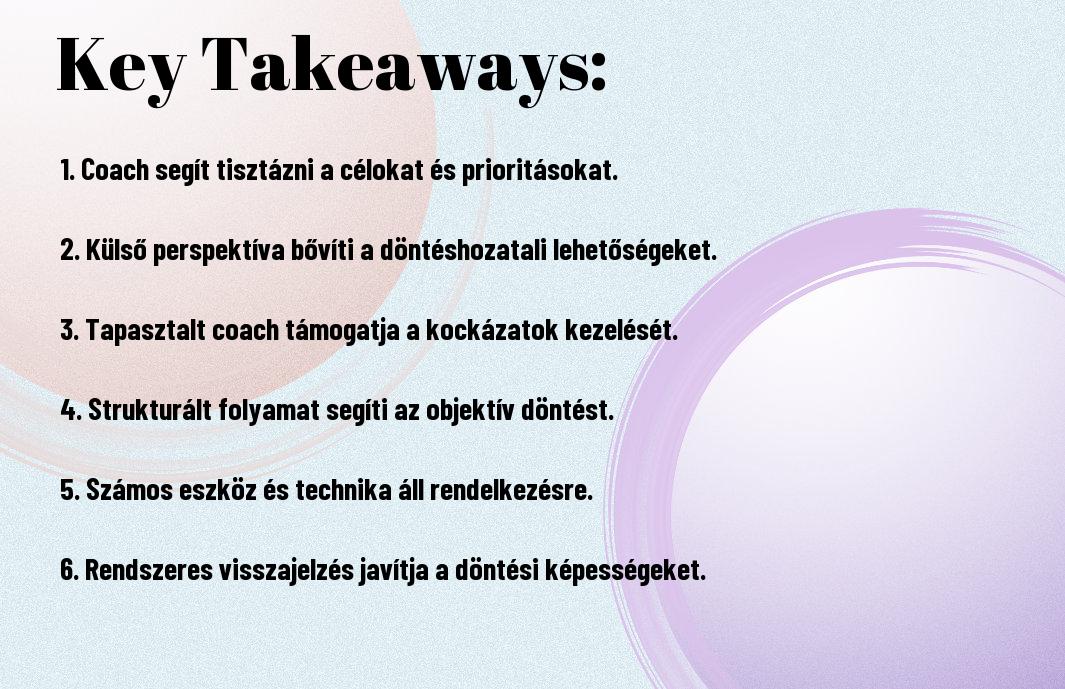
Key takeaways:
- An experienced business coach can help you increase self-awareness, which improves your decision-making skills.
- By practising strategic thinking and planning, the coach supports the achievement of long-term goals.
- Through regular feedback and support, the coach helps to speed up decision-making processes and minimise mistakes.
The Basics of Decision Making
Understanding the basics of decision-making is essential to improve the quality of its decisions. It is important to be aware of the personal values and goals, as they guide your choices. A transparent and informed decision-making process will help you to avoid wrong choices, and promote the successful and effective steps in business.
Steps in the Decision Process
The steps in the decision-making process include identifying the problem, gathering information, considering the options and making a decision. Each of these steps is key to making an informed and informed choices to bring. Careful preparation and consideration of the alternatives will help you make the most of the situation.
Measuring the Effectiveness of Decision Making
When measuring the effectiveness of decision-making, it is important to monitor the the consequences of its decisions. It is worth looking back at the decisions taken and how they have contributed to to achieve its objectives. In addition, it may be useful to feedback from your colleagues or business partners to make you more aware of the impact of your decisions.
When measuring the effectiveness of decision-making, pay attention to the to monitor processes, which allows you to successfully identify areas where improvement is needed. Use action plans to record your results and incorporate your experiences into future decisions. Remember that regular evaluation and learning a key to effective decision-making to ensure your development and success in business.
The Role of the Business Coach
The role of the business coach is to help individuals and companies improve the decision-making process and support them in developing more effective strategies. The business coach as an external eye is able to see the situation and provide new perspectives that will help in achieving your goals. The cooperation between coach and client allows for both personal and professional development.
What is a Business Coach?
A business coach is an experienced professional who an advisory role and helps companies, managers and employees to improve their business performance. They use techniques and methods that strengthen decision-making skills, and support the achievement of the goals set. Business coaches do not just give advice, they with targeted questions help clients to gain deeper self-awareness and knowledge.
Benefits of the Business Coach
The business coach helps you in the decision-making process, as their professional knowledge and through their experience provide practical tips and solutions. They also support the personal development, which is essential for to manage change and to achieve corporate goals. A business coach can also help you to find it at the best direction for your business, while supporting your strategic thinking and the proactive decision-making.
The benefits of being a business coach include helping you to overcome challenges and problems effective management of, as well as the in focus for corporate purposes. Through the experience of coaches valuable insights which can help you avoid the risk of common pitfalls and successfully navigate the complex business environment. In addition, the coach's personalised approach ensures that you the results achieved are sustainable, so they can support your development even in future challenges.
Decision-making Strategies
A decision-making strategies help you to approach your decisions consciously and effectively. With the help of a business coach, you can develop these strategies to make faster and more informed choices. The key to successful decision-making is to understand the process and consider all relevant factors.
Problem Identification
The first step in decision-making is to problem identification. This ensures that you are aware of the situation you are facing. Ask yourself what is causing the problem and what the consequences might be if you do not deal with it. This is where a business coach can help you to get a clearer picture of the situation.
Assessment of alternatives
Once you have identified the problem, the next step is to evaluation of alternatives. It's important to consider several options, as the best decision is often made from the best-weighed alternatives. An experienced coach can help you to discuss each option in detail, taking into account the potential advantages and disadvantages.
When evaluating an alternative, think about the resources needed, the time commitment, and the risks is. The aim is to find solutions that deliver not only immediate but also long-term benefits. A coach can help you to realistically assess your options and their realities, which will prevent hasty decisions.

Communication and Decision Making
A communications plays a key role in the decision-making process, as the right transfer and understanding of information is essential for making good decisions. When you enlist the help of an experienced business coach, you will learn how to communicate effectively to avoid misunderstandings and conflicts that can hinder your decision making.
Oral and Written Communication
A oral and written communication are very different, but both are important when making decisions. In oral communication, the test language and tone of voice also affect the understanding of the message, while written communication requires precise wording and clear expression. Clear messages help you make better decisions more quickly.
Teamwork Effects
A teamwork has a significant impact on decision-making, enriching the process by bringing together different perspectives and experiences. Collaborative working allows for faster sharing of information and creative solutions that can enhance the decisions quality. It also reduces uncertainty during meetings, as team members can helping each other make the best decisions.
Tools and Technology in Decision Making
In the modern world, the decision-making process is significantly may improve the right Tools and technologies using. Digital solutions, such as project management software and online communication platforms, allow you to easily access the information you need and coordinate your team's work more effectively. These tools help you to faster and more decisive avoid unnecessary delays and bad decisions.
Use of Digital Tools
Digital tools such as cloud-based applications and calendar software allow you to better organise your daily tasks. In addition, these tools in real time provide information and feedback, so you can make decisions quickly and accurately.
Data-driven decisions
The data-driven decisions can help you get the best possible results from your business. Analysing and interpreting data allows you to take an objective and factual approach that reduces errors caused by subjective factors. However, it is important to rely not only on the data, but also on combine them with your experience and intuition, because that's how you can really effective decisions.
Practical Tips for Effective Decision Making
For effective decision-making, it is important to systematically and conscious approach. Use prioritisation lists, on which you list the tasks and prioritise them according to how urgent and important they are. Don't forget the your goals to keep in mind and always take them into account when making your decisions.
Time management
Time management is a key factor in decision-making. Create plan, which will help you organise your day so you can avoid scramble and stress. Use a diary or digital apps to keep track of your tasks and deadlines.
Reflection and Lessons Learned
Throughout the decision-making process, it is worth reflect on your experience. Ask yourself how your choices have affected the situation and what you have learned from it. A lessons learned will help avoid past mistakes and ensure that future decisions are more informed.
When reflecting, it is important to consider the consequences of your decisions. Write a diary in which you record the positive and negative negative results, so you have a better understanding of what worked and what didn't. Use concrete examplesto get a clearer picture of your own decision-making patterns. This will help you to improve and inform your future decisions. are better established will be.
How to Improve Your Decision Making with the Help of an Experienced Business Coach?
With the help of an experienced business coach, you can significantly improve your decision-making processes. A coach can offer new perspectives and strategies that help you to see through complex situations and make more informed decisions. By becoming mentally prepared, you will be able to avoid common pitfalls and steer the future of your business with confidence and purpose. So don't hesitate to seek professional support to optimise your decision-making skills!
FAQ
Q: How can an experienced business coach help me in my decision-making process?
A: An experienced business coach can help by providing structured approaches, strategies and tools to make decisions. They can help you identify factors that influence decision-making and provide an objective outside perspective that can help you find the right direction. They ask detailed questions that allow for deeper self-reflection and a more thorough consideration of alternative options.
Q: What specific techniques can help me improve my decision-making skills with the help of a coach?
A: A number of techniques are available, such as SWOT analysis (strengths, weaknesses, opportunities, threats), priority lists and evaluation of alternatives. A coach can guide you in the use of thinking models, such as rapid decision making or long-term planning methods. These techniques allow you to see your options more clearly and be better prepared to deal with potential risks.
Q: How important is the personal relationship between coach and coachee for effective decision-making?
A: Personal contact is key in the coaching process. Trust and openness allow the coachee to freely share their thoughts, feelings and fears, which helps to achieve a deeper understanding. In a trusting and supportive environment, the coachee can more easily immerse themselves in their own thinking and discover other perspectives that can help them make wiser decisions.