Welcome! Today I am sharing with you my best coach techniques, which can help you easily you can achieve your goals. Life is full of challenges, but with the right tools and methods, you can be one step closer to your dreams. Here you'll find strategies that are not only effective, but motivational to be at your best! Ready to discover what you can do to succeed?
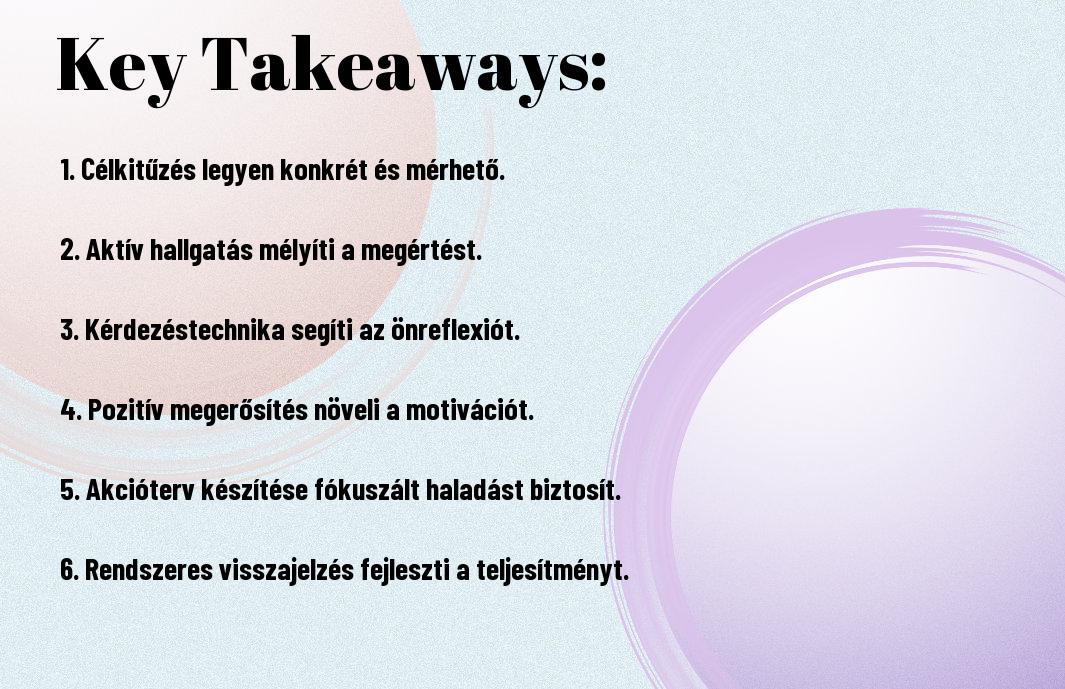
Key takeaways:
- Set clear goals and a step-by-step timetable to track your progress.
- Use motivational techniques such as visualisation or positive reinforcement to keep your enthusiasm up and avoid feelings of failure.
- Find a mentor or coach who can offer their experience and knowledge to help you be more focused and effective in achieving your goals.
What is the Coach Technique?
The coach technique is a effective methodthat helps people achieve the goals they set themselves. By I understand your individual needs and challenges, I offer different strategies and tools to help you overcome obstacles. So you can more easily and faster you can make your dreams come true!
Principles and basic concepts
The basic principles of coaching techniques include self-awareness, a goal orientation and the future centricity. These basic concepts will help you to discover your own strengths and weaknesses, making it easier to find solutions. Also an important part of the coach technique is motivation and the supportthat contribute to your development.
Role of the Life Coach
A coach szerepe kulcsfontosságú a fejlődésed szempontjából. A coach nemcsak egy támogató, hanem egy managing who will help you identify the goals you want to achieve and work out the for their implementation the necessary steps. Working together, we can share experiences and new perspectives to help you better understand your own motivations and use them to achieve your goals.
Objective and Planning
When it comes to achieving your goals, the Objective and the Design essential steps. I believe that well-defined goals help you stay focused and motivated to move forward. Planning your path will make it much easier to move towards your goals and avoid unnecessary obstacles.
Setting SMART targets
SMART goal setting is a great method that I use all the time. The acronym SMART stands for Specific, Measurable, Available at, Relevant and Time-bound is made up of the initial letters of words. This makes it easier for you to track your progress, and you can always see clearly where you are on the path to your goals.
Preparing an action plan
When preparing your action plan, it is important to detail the steps you need to take to achieve your goals. I always make it a point to break down my actions into small steps, because that way I avoid overload and the frustration. If you are clear about what you need to do, the your motivation is also constantly maintained.
When drawing up your action plan, it is worth thinking about the concrete steps you will take to achieve your goals. Think about the right action steps to take deadlines and the necessary Resources. The action plan not only helps you to focus, but also gives you motivation when you see the progress you are making through the steps you have taken. I always recommend that you regularly review and update your plans to adapt to changing circumstances.
Communication Techniques
Communication techniques are key in coaching, as being able to connect effectively with others is essential to achieving your goals. I always strive to have a clear and open dialogue to understand each other's needs and goals. Whether it is individual or group coaching, it is important that communication is dynamic and supportive.
Active listening
Active listening is one of the most valuable skills a coach should use. Here, you listen not only to words, but also to feelings and body language. When you *listen attentively*, you feel empathy and understanding, which *improves relationships* and promotes development. It is a powerful tool for deepening self-awareness.
Effective questioning
Effective questioning is a key tool in my coaching. My questions help me to gain a deeper understanding of my clients' goals and feelings. When I ask the right questions, I *enhance self-reflection* and *help with insight*. A good question can give direction to the conversation and *bring out creative solutions* to problems.
Effective questioning is not just about seeking answers, but also about *supporting the client's inner development*. I try to ask open-ended, provocative questions that *help you think* and give space for emotions. Such questions encourage *self-discovery* and allow my clients to better understand their own motivations and barriers. By asking the right questions, we can create opportunities for growth and change!
Maintaining Motivation
To achieve your goals it is essential to maintain motivation at all times. It can be difficult at times, but it's important to use techniques that help you stay determined. I always make sure that you keep your resolve small, but solemn steps to keep my enthusiasm up and remind myself why I set out to achieve my goals.
Internal and external motivation
A motivation can be found at internal and external. Internal motivation you are the driving force: your passion and your values are what you expect of yourself. External motivation can be a reward for working hard. I've found that intrinsic motivation is much more lasting, as it is more deeply connected to my personal goals.
Habit forming
The key to habit formation is consistency and the perseverance. To strengthen your commitment to your goals, start developing small, achievable habits. That's what I did, and the small steps paid off very quickly.
A habit formation the key is to take it step by step. Start small, but specific objectives that you are able to meet. For example, I spend 10 minutes every morning reading, which helps to reinforce my knowledge and keep me motivated. The most important thing is to don't give up, if sometimes it gets difficult! Small successes in themselves boost our self-esteem and increase our perseverance.
Feedback and self-assessment
Feedback and self-assessment are key elements of development. From attention feedback from the people around you can help you understand the direction you are heading in. And self-assessment gives you the opportunity to honestly examine your results and learn from your experience. If you practice them consciously, you are more likely to achieve your goals.
The role of positive feedback
The positive feedback is extremely important in your development, because it confirms what you consider to be your good performance. When I hear words of appreciation, it motivates me to keep improving and to keep going in that direction. From joyful confirmation gives me a sense of security, which helps me to be the best I can be.
Self-assessment exercises
Self-assessment exercises are a great opportunity to. understand more deeply yourself and your development potential. These exercises can take different forms, such as writing a diary, setting goals, or analysing my daily activities. The most important thing is that do them consciously and regularly, that real changes happen in my life.
Case studies and success stories
The case studies and success stories are a real inspiration for us. When I see how others overcoming challenges and achieve their goals, always motivates me too. We can learn a lot from stories like this, because it's not only the actions that are important, but also the underlying thoughts and strategies.
Inspiring examples
I have read about people who have risen from the most difficult situations. For example, an applicant who lost his job and started his own business, and now runs a successful business. His story shows that never give up, and there is always hope for change.
Lessons learned and their application
Lessons learned from success stories can help us to achieve our own goals in a similar way. approaches to use. The importance of overcoming ourselves, perseverance and planning are also key to success. If others have achieved their goals, we can follow them!
One of the most important lessons I take away from these stories is perseverance and courage. Life is full of difficulties, but if you have the right your mental attitude and your goal, challenges can only motivate you more. So it is worth incorporating the strategies and experiences of successful people into my own life so that I can achieve my goals.
The Best Coach Techniques to Help You Achieve Your Goals
In conclusion, the coaching techniques I have discovered really help you to achieve your goals. If you pay attention to your goals, positive affirmations and planning concrete steps, you will feel the change. Deepening your self-awareness and focusing will help you feel more confident along your journey. Don't hesitate to try these techniques - results are worth working for!
FAQ
Q: What coaching techniques can I use to achieve my goals?
A: There are many coaching techniques you can use to help you achieve your goals. One of the most effective techniques is the SMART goal, which means that your goals should be Specific, Measurable, Attainable, Relevant and Time-bound. In addition, visualisation techniques can also help, where you visualise your ultimate goal, giving you motivation for the steps you need to take to achieve it.
Q: How can I maintain my motivation during the coaching process?
A: To stay motivated, it's important to keep track of your progress. Keep a diary where you record your goals and milestones. Also use positive reinforcements to remind yourself of your goals and success. In addition, a supportive community from which you can draw inspiration and support can also boost your motivation levels.
Q: What are the obstacles I need to take into account to achieve my goals and how can I overcome them?
A: Barriers cover a wide spectrum, such as fear of failure, procrastination, or external negative influences. To overcome such obstacles, it is important to plan your responses in advance. Make a list of possible obstacles and develop strategies to deal with them. It is also worth seeking the help of a coach, who can support you in difficult moments and help you deal with situations appropriately.