The modern business world is full of challenges that are difficult to overcome. It's important to be aware of how you can manage stress effectively to keep your high performance and your mental health. From business coaching can help you to develop your leadership skills and find the right ways to deal with forms of stress. In this article, we show how coaching can support you to more positive and more durable achieve results in your career.
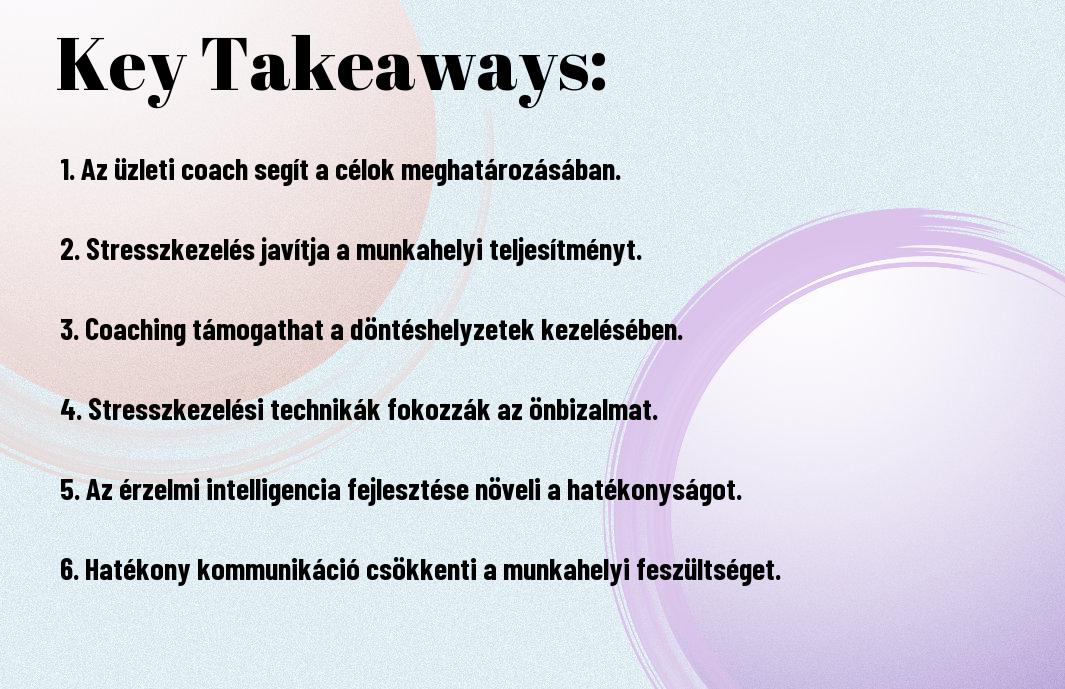
Key takeaways:
- A business coach can help you to manage stress, as personalised support and strategies can make it easier to cope with stressful situations.
- During the coaching process, entrepreneurs learn self-awareness, which helps them to identify and manage sources of stress.
- Integrating stress management techniques into business coaching can contribute to better performance and long-term success in business.
The role of the business coach
The business coach plays a key role in the lives of entrepreneurs and business leaders. He is the one who help to help you achieve your goals, giving you direction to tackle challenges. Through the coaching process you can increase your performance, while improving your workplace stress management is. With the support of a coach, you will be able to better understand yourself and your team.
Functions of the coach
The coach's functions include increase motivation, clarify objectives and facilitate problem solving. Support alone is not enough, as it must be based on a thorough assessment of the opportunities and the limits is. It can help you identify the changes you need to make to make your business a success.
Coaching techniques
The variety of coaching techniques allows you to choose the one that best suits your situation. These include Enquiry, which stimulates your thinking, as well as your feedback, which will help you clarify your goals. From active listening technique is also essential, as it allows you to sense the conditions and understand the dynamics of your team.
The concept of stress
A stress is a normal part of life, reacting to environmental challenges and pressures. When stressful situations your body naturally reacts to cope with the situation. It is important to understand that stress is not always negative, because in some cases can also be motivating, but prolonged stress can have a detrimental effect on your health and mental well-being.
Physiological responses to stress
During stress, your body uses different physiological reactions such as an increase in heart rate and blood pressure. These reactions help you to recognise and respond to danger, but if they persist they can cause adverse effects such as heart disease or mental problems.
Types of stress
There are several types of stress, including acute stress, which lasts for a short time and is usually linked to specific events, and chronic stress, which is present over a long period of time and is a constant burden on the body. In addition, we can understand the positive stress, which helps in the development and negative stress, which can have harmful consequences for your life.
Types of stress include acute stress, which is sudden and temporary, often triggered by an event such as an exam or an important business meeting. In contrast. chronic stress develops slowly and lasts for a long time, for example in a difficult work environment or family problems. A positive stress can boost your performance, while the negative stress can have serious consequences, which is why it is important to maintain balance and use stress management techniques in your life.
Stress management techniques
A stress management techniques is essential to improve your mental health and increase your productivity. Various methods are available to help reduce stress, such as relaxation, proper time management and physical activity. These not only reduce stress levels, but also help to for a better mood and the for more effective workplace performance is.
Relaxation methods
A relaxation methods can help reduce stress and improve mental well-being. Try different techniques such as meditation, breathing exercises or Yoga to find the one that works best for you. These practices will help you to for a calmer everyday life.
Time management
A good time management key to managing stress. If you manage your time efficiently, you will face less stress when meeting deadlines and completing tasks. Use planners or simpler, paper-based calendars to set priorities.
A productive time management not only helps to reduce stress at work, but also helps you to find a better balance between your leisure time and your private life. Set up priorities between your daily tasks and take regular breaks to recover. Remember that planning and organisation not only improves your performance at work, but also your your daily quality of life also significantly improves. Use diaries so you can see clearly when you need what and what your deadlines are. your main tasks.
The relationship between the business coach and stress management
The relationship between business coaches and stress management is closer than you think. From business coach not only focuses on your professional development, but also helps you to your emotional well-being which is essential to work effectively. To manage stress and achieve your goals, with the guidance of a business coach, you can learn how to maintain a work-life balance, thereby reducing stress levels.
Synergies between coaching and stress management
The synergies between coaching and stress management highlight the need for personal development and the stress management go hand in hand. The support provided by a business coach allows you to identify sources of stress and work in a targeted way to deal with these situations effectively. The coaching process helps you to experience stressful moments more consciously and face them in a positive way.
Case studies
Through case studies, you can see the real results of combining coaching and stress management. For example, an executive who works regularly with a coach has significantly reduced his stress at work by setting realistic goals and the stress management methods thanks to. Such experiences provide insights into how effective coaching can be in dealing with everyday stress.

Practical tips for stress management
To help you manage stress, there are a number of practical methods to help you reduce stress levels and improve your daily quality of life. For example, you can use mindfulness incorporating exercises into your daily routine, or physical activity increase, which not only has a positive effect on your physical health, but also on your mental state. It is also important to get the right relaxation techniques to ensure that stress levels are managed appropriately.
Mindfulness and meditation
A mindfulness and meditation practice can help you to be mindfully present in the moment and thus reduce your stress levels. These techniques allow you to better understand your thoughts and feelings, so you can respond to them without losing control. By practising meditation or breathing exercises for a few minutes a day, you can experience significant improvements in your ability to manage stress.
Importance of physical activity
A physical activity plays a crucial role in stress management. During regular exercise, your body produces endorphins, which are natural mood enhancers. Physical activity also helps to relieve tension and clear your mind. So exercise is not only good for your body, it's also essential for your focus and mental health.
If you regularly do you do sport, it contributes to the reduce stress levels and improves your mood. Exercise is not only great for your physical health, but it also improves your wellbeing by releasing endorphins. Aerobic exercise, such as running, swimming or cycling, is particularly effective in relieving stress. Set your goals and incorporate as much movement into your day as possible to really feel the benefits of physical activity.
Competences of business coaches
The business coaches competences include a wide range of skills that help them to support their clients effectively. Prominent among these skills are communications, a problem solving and the emotional intelligence. Well-developed competences enable coaches to take a personalised approach while taking into account their clients' business objectives.
Communication skills
A communication skills are essential for business coaches. Successful communication helps you to convey information clearly and understandably while identifying your clients' needs and challenges. Active and open dialogue allows you to build deeper relationships and gain trust from your clients.
Empathy and active listening
The empathy and the active listening essential skills for a business coach. To truly understand, it is important to listen carefully to your clients while also taking into account their emotional state. This gives you the opportunity to build solutions on the basis of what your clients really want to achieve.
The empathy and the active listening qualification not only builds a trusting relationship, but also helps you to gain a deeper understanding of your clients' needs and motivations. When you really listen and are able to empathise with their situation, it helps you to guide them more accurately on their path to development. Together, these two things lead to stronger motivation and commitment, which can be the key to success in business coaching.
Business coach and stress management
A business coach will help you to deal effectively with the stress that can come with workplace challenges. Through the coaching process, you will learn self-awareness, effective communication and prioritisation so you can improve your performance by reducing stress. You will also learn how to become more flexible to changing circumstances and how to tailor your work environment to your own needs. Remember. a successful leader not only gets results, but also manages stress manage.
FAQ
Q: What is the role of a business coach in stress management?
A: A business coach helps clients identify sources of stress in their workplace and develop effective stress management strategies. Business coaches teach techniques to help manage increased stress, such as setting priorities, effective time management and conflict management. They also provide a supportive environment where clients can share their difficulties and find solutions.
Q: What impact does stress management have on business performance?
A: Stress management has a significant impact on business performance as it can reduce the risk of burnout, improve employee morale and boost creativity. Employees who manage stress effectively tend to be more productive, more cooperative with others and better able to adapt to a changing environment. It is therefore important that companies support business coaching programmes that also focus on stress management.
Q: How do I choose the right business coach for stress management?
A: When choosing the right business coach, it is important to consider at least a few factors. First, look for coaches who have experience in stress management and who can offer solutions tailored to your personal needs throughout the work process. It's also worth checking the coach's references and credentials, and getting to know the coach's style and approach through a personal interview to see how we can work with them on our problems.